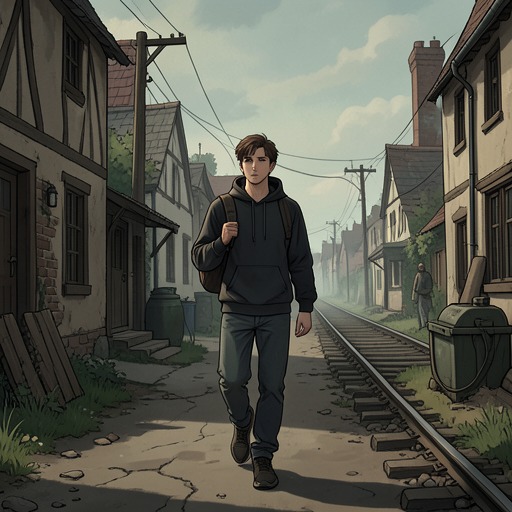
Anthony Casati
And Their Children After ThemAnthony Casati’s life follows the difficult passage from a restless adolescence in Heillange to an adulthood marked by military service, temporary work, and an attachment he cannot easily leave behind. A red-and-white Yamaha first gives form to his desire for speed and escape; its disappearance helps tip ordinary teenage dissatisfaction into a sense of being trapped. As the family’s fortunes narrow and the town’s industrial crisis endures, Anthony moves repeatedly between flight and return, ending with a feeling of freedom that is real but not a simple escape from the past.
Identity and Early Life
Anthony is fourteen during the summer when his story begins. At first, the world still has the familiar rhythm of school, classes, friends, and ordinary pleasures. Later, he remembers how easily those days once linked together, with a pop quiz among his biggest worries. That ease gives way to a feeling of being stuck in mud, as if the days had become a prison. The change registers not as a single declared decision but as a widening distance between the life he expected and the life he can imagine ahead.
At the beginning, Anthony stands on the shore and stares, an image that places him at the edge of a landscape before the narrative has explained what it means to him. The motorcycle that he finds in his family’s garage gives his longing a more tangible shape. The red-and-white 1982 Yamaha YZ, number 16, is wedged behind an old ping-pong table and covered by a tarp. His father, Patrick Casati, had raced motorcycles in the past and sometimes lets Anthony ride the Yamaha around the neighborhood when he is in a good mood. Anthony feels at ease shifting gears and leaning into turns, and imagines owning a bike of his own. His motorcycling obsession folds together fantasies of the seaside, sunsets, girls in bathing suits, and Aerosmith songs: speed is bound up with a larger, still indistinct vision of freedom.
The Motorcycle and Adolescent Crisis
The Yamaha’s disappearance becomes a decisive rupture. Anthony finds it missing from its usual place and drops to his knees. What had been both a coveted object and a route into imagined independence is suddenly gone. The loss feeds a period of anger and disorientation: he runs without knowing where to go and has no intention of returning home. The contrast with his earlier routine is sharp. What once seemed sufficient now feels repetitive and confining, and he cannot recover the uncomplicated happiness he remembers.
Anthony’s troubles also bring him into places and situations beyond the family garage. After visiting Malek Bouali with his mother, he crosses the ZUP’s parking lots, flower beds, grassy mounds, and benches marked with graffiti. Residents watch from their windows, while mopeds circle through the estate. Beyond it, cars speed along the viaduct toward or away from Paris. The scene places Anthony and Hélène within a landscape of housing and movement, with the road offering a distant direction out but not, by itself, a way to leave.
At another point, Anthony finds Sonia in a storeroom. She is listening to rock music through headphones and staring at her bitten fingernails; she does not hear him enter. The brief encounter adds to the portrait of young people absorbed in private spaces and moods, rather than supplying an easy explanation for Anthony’s own unsettledness. Later, after trouble at the sailing club, he leaves with his mouth bleeding, having forgotten his helmet, and rides as fast as he can without knowing where he is going. Across these episodes, movement offers him an outlet, but rarely a destination.
Family Bonds and the Cost of Violence
Anthony’s relationship with Patrick changes after he and his mother live apart from his father. He arrives at Patrick’s home punctually, around seven, and they embrace at the threshold. Away from Hélène’s presence, they must learn how to get along without the old hostility that had once structured their relationship. In its place is affectionate embarrassment. Both are cautious around subjects that might reopen conflict, so the improvement is genuine but tentative.
That fragile calm makes the violence at L’Usine especially consequential. Anthony is in the men’s room after drinking five beers, whistling and feeling unusually optimistic because relations between his parents have improved and Patrick appears to be keeping his pledge. Then the door opens, and the scene turns. Patrick gives a chuckle and throws the first punch. The family pays heavily for the resulting fight: Patrick faces trial, loses his job, and is left with legal fees, a fine, and debts he is unlikely to repay. Anthony recognizes that his mother has already endured the divorce and the strain of the trial, and his earlier irritation gives way as he takes account of the damage done to her and to the household.
Anthony also understands that his own adolescence has been partly sheltered by its legal limits. People have told him he is lucky to be a minor. He has spent those years looking for trouble, getting involved in drug deals, stealing scooters, skipping classes, and damaging public infrastructure. But that protection has an abrupt endpoint: adulthood brings consequences and demands that he had dreaded without quite believing would arrive. The army appeals as another place to take refuge, one where he would only have to follow orders. His decision is not presented as a confident career plan so much as a response to the narrowing alternatives around him.
Leaving School, Service, and Work
Anthony turns eighteen in May and passes the technological baccalauréat in June, without needing oral examinations and without illusions about what will follow. Earlier that spring, a career fair in Metz had displayed options he knew little about: technical and engineering qualifications, university courses, and military service. At the army booth, a cheerful recruiter shows him a prospectus and a CD with images of a marine, a submariner, a helicopter pilot, and jungle training in Guyana. The vivid range of possible lives stands against Anthony’s lack of a clear civilian plan; the army offers structure at a moment when his familiar protection as a minor has ended.
During his service, Anthony injures his knee playing soccer after class. After a week in the infirmary, continued pain and an episode in which a nurse finds him unconscious on the floor lead to further medical attention. A doctor orders him back to France for surgery at the Saint-Mandé military hospital. Six months of physical therapy follow, and Anthony is then sent back to Germany. The account later shifts to civilian life and temporary jobs, without detailing the precise circumstances of his departure from the army.
Afterward, Anthony does not dare cash the check the army has given him. He fears the money will vanish and leave him poor again, dependent on his mother and feeling like a child. Instead, he takes temporary work: cleaning bathrooms at the Saint-Vincent clinic, working at the abattoirs, serving as a school janitor, and joining the kitchen crew at the prefecture. That last job is so far away that fuel consumes nearly all his pay. On the advice of the woman handling his case at Manpower, he keeps it for eight weeks, waking at dawn to drive sixty miles, work four hours, and drive home. The sequence makes adulthood less a clean break than a succession of laborious efforts to avoid falling back into dependence.
Stéphanie, Return, and Freedom
Anthony’s attachment to Stéphanie persists across these changes. At one point, he returns from the forest and finds Stéphanie and Clémence dancing together. They copy each other’s movements, arms raised, and after a couple of songs Clémence whispers something to Stéphanie and leaves the floor. Anthony sees the scene, but his later life does not settle into a straightforward romance. His longing remains largely unspoken and continues to shape his private choices.
Sometimes, late at night, after drinking more than usual, Anthony takes a beer down to the parking lot, gets into his Clio, finds something good on the radio, lights a cigarette, and drives north toward Stéphanie’s neighborhood. These journeys are recurrent rather than decisive: he does not speak about them, and they do not resolve what he feels. Much later, after returning to Heillange, he comes by himself. He does not want to see Patrick or his friends; he wants to savor the certainty that he is finally done with the town. Walking with his hands in his pockets, he feels almost like a tourist among a landscape and crowd that no longer concern him. He is leaving the following day.
At their final farewell, Stéphanie raises her hand. Anthony experiences the parting as the end of a longing that has been growing inside him for nearly a lifetime. The closed door makes the loss concrete, while the remembered image of her ponytail on a July day links the ending to the earlier years from which he has never entirely separated himself. Yet the book does not leave him only in regret: in spite of everything, Anthony feels free.
His sense of release sits against a wider history of Heillange. The factories have closed and the blast furnaces have fallen silent; the men of the older generation, including those who were attentive fathers or quiet and obedient workers, have carried the crisis into family life and then died. Their sons have often caused worry before settling down, while women have borne years of hardship and mistreatment. The crisis, the narrative insists, has outlasted the moment when it first began. Anthony’s freedom therefore does not mean that the economic and familial damage has disappeared. It marks a personal change within a landscape still shaped by decline: he can leave, but the life that formed him remains visible in what he remembers and in what he has had to escape.